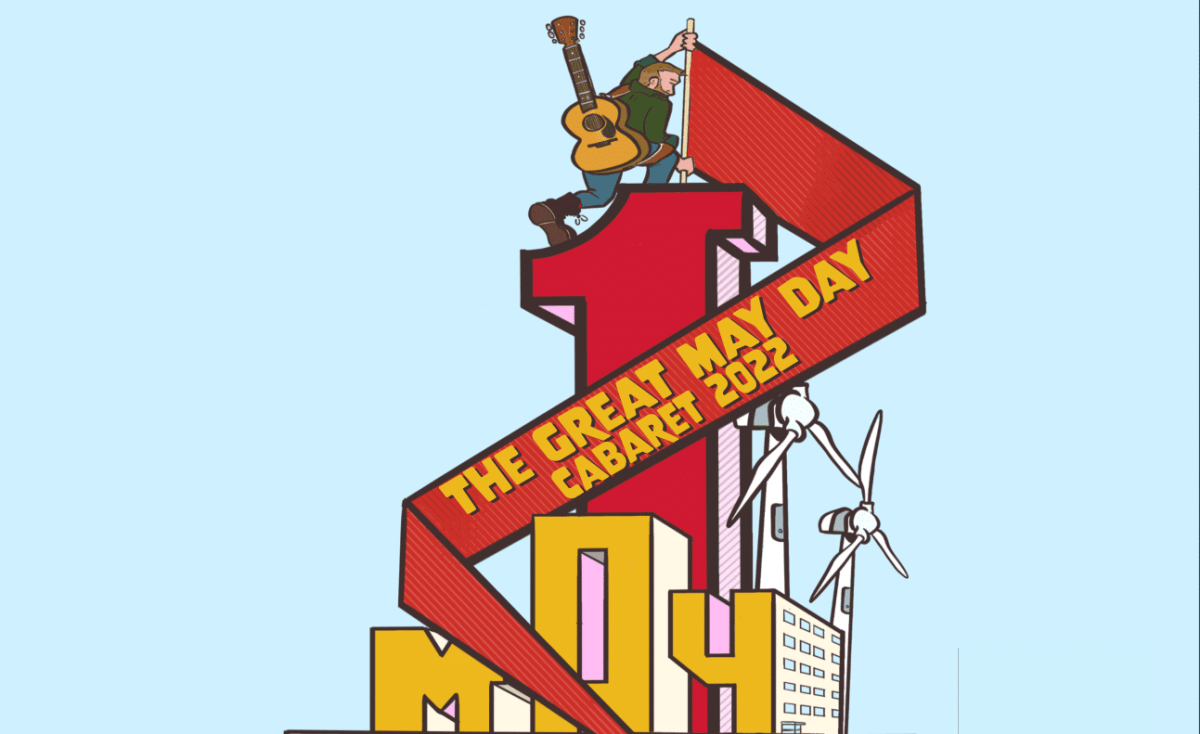
Two May Day cabaret events.

The STUC have partnered with FairPley as part of their 125th anniversary year to offer two May Day cabaret events.

Dates and Venues

Sunday May 1st – Edinburgh Great May Day Cabaret

https://www.eventbrite.co.uk/e/the-great-may-day-cabaret-tickets-290572549317
Edinburgh Southside Community Centre 7:30 pm

Featuring a fantastic line-up, the Great May Day Cabaret is a cultural celebration of both international workers’ day and the 125th anniversary of the Scottish TUC.

Performers include singer-songwriter and national treasure Rab Noakes; songwriter and producer Becci Wallace; musician and activist Calum Baird; poet and former refugee and political prisoner Ghazi Hussein; Yemeni Musician Saber Bamatraf and spoken word artist Iona Lee. Hosted by the incomparable Susan Morrison.

Supported by Edinburgh & Lothians May Day Committee, Fair Pley, STUC, Art 27, and Peace & Justice Project.

Monday May 2nd – Glasgow Great May Day Cabaret

https://www.ticketweb.uk/event/the-great-may-day-cabaret-oran-mor-tickets/11882335?pl=oranmor

Glasgow Oran Mor 7:30pm

Featuring another fantastic line-up, the Great May Day Cabaret is back to help celebrate the 125th anniversary of the Scottish TUC.
 
Celebrating international workers’ day are singer-songwriter and national treasure Rab Noakes; harmonica wizard Fraser Speirs; MG ALBA Scots Trad Music Awards Musician of the Year Iona Fyfe; Gaelic songstress Kathleen MacInnes; comedian Philip Differ; John Byrne Annual Award winner Victoria McNulty; BBC Radio Scotland’s Young Traditional Musician of the Year 2021 Michael Biggins; and the force of nature that is Rosa Moxham.  Compered by the second-best poet to come out of Ayrshire Jim Monaghan and with special guests David Hayman and Roz Foyer STUC General Secretary.
 
Supported by UNITE and STUC.

International women’s day 8 March

Did you know – about women?

Did you know Union has over 1 million female members and that Unison was formed in 1993 – UNISON was created in 1993 through the merger of several unions, including the National Union of Public Employees (formed 1905) and the Confederation of Health Service Employees (formed 1910). It maintains a separate political fund, which supports the activities of the Labour Party.

Did you know the first woman’s strike in the UK began on 7 June 1968. Women machinists at Ford’s Dagenham car factory have gone on strike. They are protesting about the re-grading of their jobs, feeling they have been treated unfairly compared with the men working in the plant. The strike would lead to equal pay legislation being introduced two years later.

Did you know that the suffragettes also helped men over 21 with the right to vote – On 6 February, the Representation of the People Act 1918 was passed – prior to this only men who owned property could vote – this enabled approx 5.5 million more men the right to vote. Thank you suffragettes.

Did you know Anna Eleanor Roosevelt was an American political figure, diplomat, and activist. She served as the first lady of the United States from 1933 to 1945, during her husband President Franklin D. Roosevelt’s four terms in office, making her the longest-serving first lady of the United States. In the postwar years, Roosevelt continued her advocacy for women’s rights at home and abroad. She continued to support the advancement of women in professional and political positions, and supported the rights of working-class women, through labor unions and other organizations.

Did you know an investigation by UN Women UK found that 97% of women aged 18-24 have been sexually harassed, with a further 96% not reporting those situations because of the belief that it would not change anything.

Did you know 1/4 Of UK Employees Bullied at work For those of you who thought that bullying ended in the playground, think again. Sadly, 1 in 4 of us have experienced bullying or been made to feel left out in their place of work.- define bullying as ’offensive, intimidating, malicious or insulting behavior, an abuse or misuse of power through means that undermine, humiliate, denigrate or injure the recipient’.

Did you know only six countries in the world give women and men equal legal work rights- If you’re a woman and want to be on an equal footing with men, it’s best to live and work in Belgium, Denmark, France, Latvia, Luxembourg or Sweden.

Did you know women used to dominate the beer industry – that is until the witch accusations started pouring in. Humans have been drinking beer for almost 7,000 years, and the original brewers were women. From the Vikings to the Egyptians, women brewed beer both for religious ceremonies and to make a practical, calorie-rich beverage for the home.

Did you know the first feminist in the UK was Mary Wolftonecraft born in London 1759 – Today Wollstonecraft is widely recognised as a principal architect in the fight for sexual equality? Her work is still published around the world. –  She remains an enduring symbol of the ongoing fight against misogyny and sexual injustice.

Did you know 1 in 3 women around the world experience violence (source. World Health Organization).

Did you know 58% of all women murdered in 2017 were killed by an intimate partner or a family member (source. United Nations Office on Drugs and Crime, 2018).

Did you know over 200 million women and girls in 30 countries have undergone female genital mutilation (source. Unicef, 2016).

Did you know women spend at least twice as much time as men on domestic work, and when all work – (paid and unpaid) – is considered, women work longer hours than men (source. The World’s Women, 2015).

Did you know over 2.7 billion women don’t have the same work opportunities as men, with laws restricting the types of jobs they can do (source. World Bank, 2018).

Did you know the US is one of only eight countries in the world that does not provide any form of paid maternity leave by federal law.

Did you know women across the world currently bear the majority of childcare but, when fathers take on at least 40% of the childcare responsibilities, they themselves are at lower risk of depression and drug abuse, and their children will average higher test scores, have stronger self-esteem, and fewer behavioural problems.

Did you know over a quarter of women seeking medical help for menopause symptoms had to visit their GP three times or more before receiving treatment or support.


Pay – A derisory offer & our rejection

The SJC Joint trade unions received a pay offer from COSLA this week(whilst it is dated the 28th of February it was in fact only sent to us on the 2nd of March). 

The UNISON Local Government Committee met the same day and decided unanimously to reject this offer immediately without going to consultation (the LG pay protocol procedures, allow for this).  We met with the other SJC Trade Unions later that day and they agreed to do likewise.

There was an SJC Steering Group meeting this morning with the employer where they formally tabled their offer and we notified them of our rejection.  We have since written to them confirming our rejection. 


UNISON will be issuing a press release on this asap and will send you further information as soon as we receive it.

read more…

Black Members in Scotland

The Scottish Black Members Committee would like feedback from our Black Members in Scotland.

In UNISON, Black is used to indicating people with a shared history of colonialism and enslavement in the past and continue to experience racism and diminished opportunities in today’s society. UNISON’s Black Members include people with African, Caribbean, Asian, Arab and other Black or mixed ethnic origins or backgrounds.

https://survey.alchemer.eu/s3/90433456/2022-2023-Unison-Scotland-Black-Members-Consultation

Covid 19 – Update to Scotland’s strategic framework

The First Minister this week announced a new staged approach to easing protective measures and recovering from the ongoing coronavirus (COVID-19) pandemic.  In her statement, she confirmed the details of the updated Strategic Framework to manage COVID-19 primarily through public health advice, vaccination, and treatment rather than legal restrictions and set out an indicative timescale for remaining legal protections to be lifted. 

Key points are:

  • Vaccine certification will no longer be legally required from Monday 28 February, although the app will remain available so any business that wishes to continue certification on a voluntary basis to reassure customers will be able to do so.
  • Current legal requirements on the use of face coverings, the collection of customer details for contact tracing purposes, and for businesses, service providers and places of worship to have regard to guidance on Covid and to take reasonably practicable measures set out in the guidance are expected to be lifted on 21 March, subject to the state of the pandemic.
  • Access to lateral flow and PCR tests will continue to be free of charge, ahead of a detailed transition plan being published on the future of Scotland’s test and protect programme in March.
  • People who test positive for COVID-19 will continue to be asked to self-isolate to reduce the risk of infecting other people. Any changes to the recommended period of self-isolation will be considered on an ongoing basis.

Full details of the announcement are here:  https://www.gov.scot/news/living-safely-with-covid/  And a copy of the updated Strategic Framework is here: https://www.gov.scot/publications/coronavirus-covid-19-scotlands-strategic-framework-update-february-2022/


The Workforce Issues Group will be discussing this at its next meeting on Friday 4th March so if you have any views or comments that you would like us to feed into that please drop me a line.

Covid 19 – Second boosters for at-risk groups

The arrangements for second boosters to be delivered to at-risk groups has been announced – details here: https://www.gov.scot/news/second-boosters-for-at-risk-groups/