
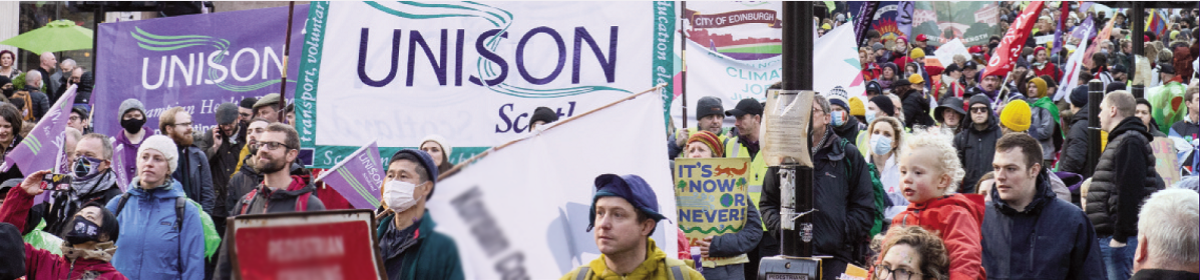
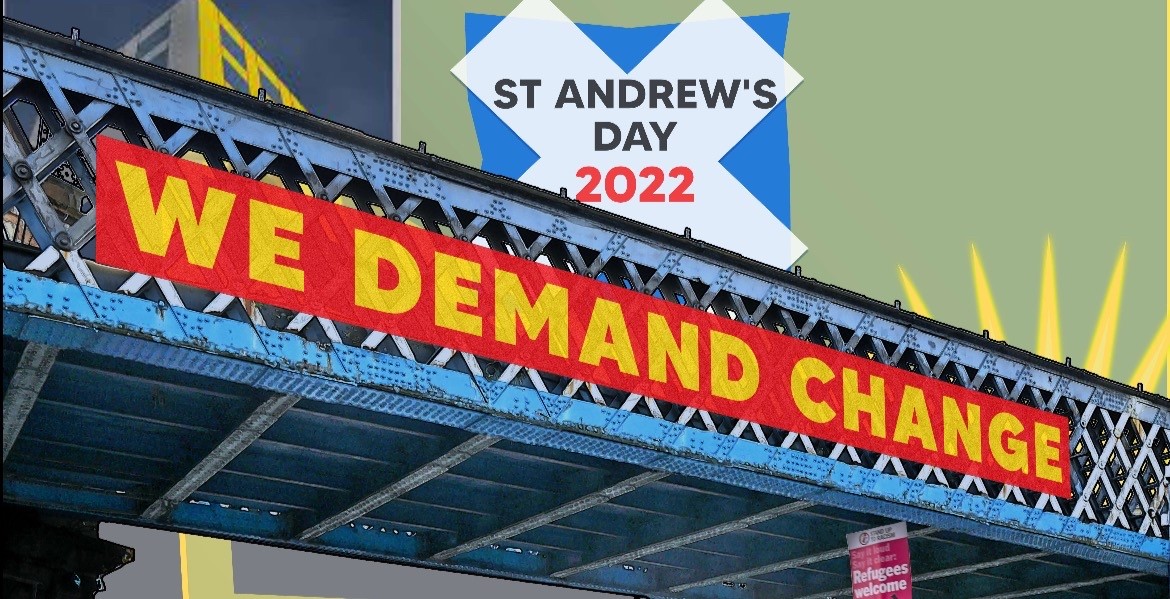
  St Andrew’s Day March and Rally Against Racism We demand change! Saturday, 26 November 2022 Assemble 10.30 am: Glasgow Green March off 11.00 am Rally 12 noon: Renfield Centre, Bath Street Bring your banners and flags! This is a crucial year for the fight against racism. The Sheku Bayoh Family Justice Campaign needs our continuing support, we must fight the racist UK Government immigration policy and rhetoric. And we face a cost of living crisis and attacks on pay that disproportionately impact black workers. Mobilise for the march and rally Forward this email to branches Request printed copies of the 2022 poster by emailing info@stuc.org.uk Posters and Social media assets will be available from 10th November on the STUC website Join STUC’s dedicated mailing list for the Support the Sheku Bayoh campaign Visit the STUC’s Sheku Bayoh Family Support website for details of the vigil on 22nd November and other events Individuals can donate to the campaign through the Justice for Sheku Bayoh crowdfunder set up by the family. Unions, union branches, and other organisations can send cheques payable to STUC, 8 Landressy Street, Glasgow G40 1BP (please mark the envelope ‘Sheku Bayoh Family Justice) or email info@stuc.org.uk for bank transfer details. |
Author: Stirling Websites
LG Pay Implementation Update

We advised we would keep you up to date on further implementations regarding the LG pay implementation. As advised previously Stirling Council is working towards having the LG pay settlement implemented in Novembers pay including back pay. We have been advised yesterday that an additional 1-day of annual leave will be paid for term-time workers in January and for those that will receive this an additional day of annual leave when this will be added soon to your annual leave entitlement, however, we were further advised yesterday by the employer that their interpretation and the lack of reference to a leave year in the COSLA circular, to mean this is a decision for individual authorities to make, as COSLA are aware Local Authorities operate different leave years. Recognising the entitlement to the additional day commenced 1st April 2022, they are proposing to pro-rata this according to a leave year, which runs January to December thus meaning that for this year 2022 Stirling council staff will only receive three-quarters of a day’s leave entitlement. Thereafter staff would then see a full day added to their entitlement, ahead of every new leave year. This is not our interpretation of what was agreed with COSLA and we are now raising/seeking further clarity on this directly with COSLA.
We have attached guidance on universal credit in line with that issued last year – there is, unfortunately, little that can be done by either the employer or ourselves to mitigate the impact of this on universal credit arrangements as those are governed by HMRC rules, however, should this give you significant concern regarding the impact the pay settlement backdated pay may have on your universal credit we would advise that you contact HR/payroll directly to see what support/help can be given to mitigate any potential loss.
I n relation to the payment of SSSC fees backdated to April 2022 whilst we are also awaiting further information on when/how this will be implemented and how this will be paid/backdated to members we have since heard that the SSSC will be managing any backdated refunds and this process going forward. It is extremely frustrating and unacceptable that UNISON has had to hear this secondhand and has had no communication to date from COSLA regarding this. In the meantime, until you hear otherwise if you are due to pay SSSC fees you must pay them.
Once we have further information on any developments we will keep you updated at the soonest opportunity.
National Care Service (Scotland) Bill

report by Abigail Robertson Stirling UNISON Branch
The National Care Service (Scotland) Bill, is the Scottish Government’s response to the recommendations within the Feeley Report. This report was commissioned by the Scottish Government to provide an independent review of Adult Social Care Services and to explore the principles of creating a National Care Service. The purpose of the Bill (NCS- Bill) is to provide a framework for the development of a National Care Service, but the result is a Bill that provides a broad-brush framework with a worrying lack of detail and many more questions than answers. This has been described by some as a “pile of blank paper”. Scottish Government aims to add detail to the Bill through the implementation of secondary legislation, and in the absence of detail, we must ask, exactly what are we being signed up to?
UNISON is not against the concept of a National Care Service. There were many elements of the Feeley report which we supported. However the Feeley report not only stopped short on the need for a ‘not for profit’ agenda in care services, it was actively promoting the private sector as part of the overall framework. This Bill falls far short of the positive recommendations within the Report and does nothing to redress the concerns UNISON expressed about Feeley’s Report.
UNISON has consulted widely on the NCS Bill, with our members, internal groups such as SWIG, Social Care Committee, IJB Reps group, the 3rd Sector, Professional Organisations, etc, and is seeking the withdrawal of this Bill. We want further engagement to develop a model of National Care from the grassroots up. We will explore the reasons for this in more depth below.
Biggest Concerns:
There are some big concerns within the Bill that cannot be ignored.
Lack of commitment to Not for Profit: We are all aware that the current care system relies heavily on the procurement of care services from the private sector. Many of these companies make substantial profits via the public purse but, their priorities are banking the money and paying shareholders not improving the quality of care they provide or improving pay and conditions for their staff. UNISON firmly believes that public money spent on care should remain within the public domain and be invested for the benefit of those who access care and staff who work within the care system.
Impact on Local Government/ Local Democracy: The current Bill is a threat to our Local Authorities. The removal of 75,000 Social Care and associated staff from our local authorities in Scotland will not only reduce the size of our Councils, it will significantly reduce the funding, and maybe only the beginning. To illustrate this, currently, Social Care makes up 33% of overall council budgets and Education makes up 47%, once Social Care is removed from the Councils into a NCS, Education funding will make up 80% of Council Budgets. This appears to be the beginning of an agenda to dismantle local government.
Local democracy will be affected because there will be no local political oversight or local democratic accountability for decisions made affecting local communities and individuals. The reduction in the size of Local Authorities means they are disempowered when it comes to representing local communities, and the NCS will be a vastly centralised system under one Scottish Government Minister.
Impact on Local Services: Currently our Social Care Services work closely with Council Colleagues in other LA services, particularly Housing and Legal Services. However, with the removal of Social Care services close liaison and valuable working partnerships with these services will be impacted.
Additionally, local issues for communities and individuals will be easier to overlook and less easy to challenge, in a ‘one size fits all’ National Care framework, consisting of a rigid system of Care market codes and procurement for ‘qualifying organisations’.
Spending costs of the proposals: Estimates from the Scottish Government are that they have set aside funding for the set-up costs for the NCS of £250m, and £500m each year. This may be a serious underestimation of the costs, as remember, this is an untested model, based on incomplete legislation. We don’t even know how many IJB’s there will be or how they will function as this is to be a matter for the Scottish Government Minister in charge to establish. Effectively, this means that much of the work and substantial cost is already undertaken to set up IJB’s, establish integrated services, etc may be money and time down the drain.
There has been a lot of chatter around the Bill improving conditions for the workforce and only purchasing care from reputable companies but let’s be clear, none of this has been written into the Bill at this stage. There has been a failure to embody the principles of the Fair Work Convention or the Ethical Care Charter, despite the Scottish Government’s previous endorsement of these campaigns.
Impact on staff/ TUPE/Professional Ethics: Not everyone currently working in Social Care will be working within the NCS going forward. The Bill specifically allows for staff outsourcing to anywhere within the services they procure. This is a significant risk, particularly for frontline care staff who may very well find themselves TUPE’d over to the 3rd Sector or Private sector employers.
Interestingly, it appears that the NCS will be able to ‘poach’ services from the NHS, such as Addiction services, Geriatrics, and MH services into the NCS, but the reverse won’t be true for Social Work or Social Care staff in terms of migration to the NHS. However, NHS staff are currently legally protected from being moved out of the NHS so this is a clear contradiction and illustrates how much work still needs to be done to make the Bill fit for practice.
Impact on UNISON LG Branches: We must also be aware of the huge impact on our current UNISON Branch and National structures of members from our biggest workforce being removed from Local Government Branches. This is certainly not a reason to reject good reform in itself, after all, UNISON would have to adapt our own structures to accommodate this change and as already mentioned UNISON is not against the concept of a National Care Service. However, it should be a real concern to Branches that a significant portion of our Branch members may be forced to change employers in such precarious circumstances.
It is also worth noting that TU representation on the new care Boards has not been specifically guaranteed, and we don’t know what this will look like. The Government Minister at the top of the structure will decide how many care Boards there will be going forward, they will also have the power to decide who sits on the boards as well as remove any representatives they choose from the Boards.
It is essential that we are all aware of the NCS Bill, and its broad impact of the Bill, be ready to share our concerns with the broader membership and be willing to show solidarity with the Social Care workforce in whatever is ahead.
What our Social Care members are saying:
Social Care Members are expressing concerns on a number of levels. They are of course concerned about their own jobs, terms and conditions, pensions, and who their employer will actually be. However, broader than that many Social Workers are concerned about the potential impact on their professional role and function because of the lack of detail about the role of Social Workers within the Bill. This indicates that the Scottish Government has failed to understand the SW role, training, or their concerns as a workforce. This is not an unusual situation, as legislation relating to SW practice has failed to utilise the skills and training of Social Workers, has constrained the role of the profession for the last 30 years, and allowed the most rewarding elements of practice to be carved up and taken on by other professionals. This has led to a demoralised, exhausted, and diminishing workforce. There has been little attempt to consult frontline Social Workers and there is little in the Bill to alleviate the concerns of this professional group. It is a huge missed opportunity.
Social Care staff are similarly concerned about their terms and conditions, who they will be employed by, and what will happen to their LG pensions. Given that these staff work closely within local communities, there are concerns that this may be negatively affected.
There is a national shortage of Social Care staff and Social Workers. Given the demographic of this workforce (predominantly women, many of whom are part time workers, and over the age of 45) there is a very real risk that the NCS will struggle to retain valuable experienced staff, who may choose other work options going forward.
What Now?
UNISON has been working with SWIG, Social Care Committee, IJB Reps group, and other relevant internal groups to gather the concerns and perspective of our members, and a variety of responses to the NCS Bill have been prepared. UNISON has also held online seminars and has been developing videos to get the message across to our members and the public. UNISON has also been working closely with the 3rd Sector, Social Work Scotland, Commonweal, and many others to campaign against the NCS Bill in its current format. It is fair to say that not all stakeholders share exactly the same concerns, but they do all have concerns about this Bill lacking the detail required to make such a massive structural change.
I am asking our Branch reps and members, to familiarise yourselves with the NCS Bill, and the concerns we have, share those concerns widely, and show solidarity with Social Care Staff because this is a Bill that will affect us all.
Global Day of Action called by Egyptian groups at COP27

Information about the mobilisations on Saturday 12 November in solidarity with the Global Day of Action called by Egyptian groups at COP27.
Details of the Edinburgh march on 12 November are in the picture and here, with registration here. It starts at 12noon in St Andrew Square and goes around several themed ‘stations’ finishing at the Scottish Parliament, where the theme is End the Cost of Living Scandal, Just Transition now.
Further details of all marches across the UK are being added to this Climate Justice Coalition (the successor to last year’s COP26 Coalition) list on the UNISON UK website.
As General Secretary Christina McAnea said in the discussion at her recent Jimmy Reid lecture, action on climate is up there in the union’s overarching top three priorities, along of course with key work to improve pay, particularly tackling low pay and our equalities work. She said climate change is intrinsically linked to poverty, with those who have least here and worldwide most affected. And she emphasised that young people, when asked why they want to join a union, refer to climate change and housing as important to them.
We know everyone has been overloaded more with work on pay and ballots but would encourage branches to support the Edinburgh demo, or one nearer you if more are organised. A lot of trade unions have made efforts during pay disputes to link the cost of living and fuel bill crises with the climate crisis and climate campaigners have been supporting pay strikes. The Just Transition Partnership has a statement-making the links between the climate crisis and cost of living and industrial disputes – Living Wages on a Living Planet.
Understandably there was more attention on the UN talks themselves when they were in Glasgow, but the fuel bills crisis and soaring profits of Shell and other oil companies, show that we are right to call for windfall taxes on those companies and a system focused on people, not profit. Report after report highlights the climate harm and dangers, including to health. And to infrastructure and life without sufficient adaptation planning. (Remember we have the excellent climate hazards workbook and handbook and other resources branches can use with employers.) Yet the new Prime Minister isn’t going to Egypt, even though the UK still has the presidency.
Yesterday’s UN environment agency report put the urgency in the strongest possible terms: Inger Anderson, executive director of the UN Environment Programme, said: “We had our chance to make incremental changes, but that time is over. Only a root-and-branch transformation of our economies and societies can save us from accelerating climate disaster.”
Our Depute Convener Stephen Smellie will be at COP27 as part of the ITUC delegation. He will send updates from there and you can find regular updates on events and info on this page on the UNISON Scotland website https://unison-scotland.org/tus-at-cop27-climate-conf-sat-12-nov-demos-green-unison/ Do please sign the petition in solidarity with Egypt’s prisoners of conscience https://copcivicspace.net/petition/
Anyone who would like to be kept in touch through our Green Network mailings can let me know at f.montgomery@unison.co.uk
The proposed national care service will not be a system like the NHS

We are writing to ask you to circulate as widely as you can – this plea for members to raise with their MSPs the grave concerns UNISON has about the National Care Service Bill currently going through the Scottish Parliament.
The proposed national care service will not be a system like the NHS. Instead what will be set up will fundamentally challenge the idea that public services should be publicly delivered. We are asking all UNISON members to raise concerns with their MSPs – which can be done by clicking here.
The Scottish Government’s aim is that the National Care Service (NCS) will bring together social work, social care, and community health. These services won’t be delivered directly by public sector bodies – but purchased by new quangos (Care Boards) from the public, private and third sectors.
All legal responsibility for these services will be transferred from local government and, if Scottish Government ministers decide, from the NHS. The impact will be enormous.
This could mean 75 000 staff being transferred out of local government to new employers (as well as upheaval for an unknown number of staff in the NHS and other agencies). If the scheme goes ahead the way the Scottish Government intends Care Boards will receive 1/3 of the budget that currently goes to councils – this will have an impact on staff across the board as councils will require fewer staff in Finance, HR, facilities management, etc.
While this is happening, the profit-making that has done such damage to the care system won’t be stopped – and a whole range of other services; from children and families services to criminal justice social work and a lot in between will be opened to tendering and contracting.
More detail on the proposal can be found in this UNISON Brief Guide to the National Care Service (Scotland) Bill.
Keep up to date with UNISON Scotland’s campaign to kick profit out of care and defend public services on the UNISON Scotland website and by following @unisonncswatch on Twitter
On behalf of the Learning and Organising Committee Chairs

Colleagues. Please see attached Newsletter from the Learning & Organising Committee for circulation within your branch. This will be a regular item to promote activities around our activist education programme.
Please feel free to send in any contribution that you might want to share in future publications.
 Stirling UNISON