


Colleagues I’d like to start congratulating and thanking all those involved in our Local Government Pay Dispute. In eight of our Councils, our waste and recycling workers came together to take strike action, In nine council areas, our schools based members were poised to do likewise. Together this brought about an unprecedented protracted negotiation between the three unions and CoSLA with Scottish Government involvement. Whilst we accept that for some the final offer fell short of their expectations and there’s no doubt for most their rising costs, this did represent a huge shift from the original offer. Our members have voted on the final offer and roughly two-thirds majority have voted to accept. This was absolutely down to the tremendous efforts of our members, activists, branches, and staff working together to deliver effective industrial action. Again, we cannot thank everyone enough for the huge amount of work they did to bring about a much-improved pay settlement. Thank you. Best wishes, Lorraine Thomson
Author: Stirling Websites
Food for thought – online public supporters meeting 6th October
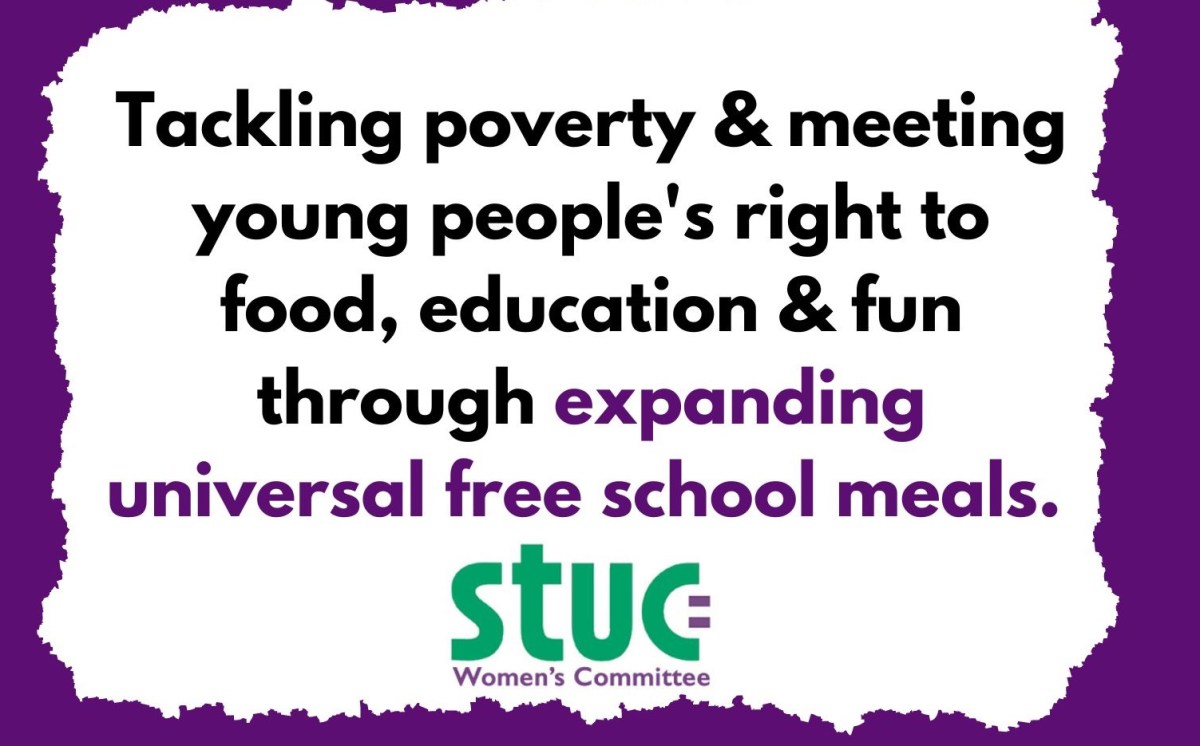
Tackling poverty and meeting young people’s rights to food education and fun through expanding universal free school meals.
#challengepovertyweek 6th October 6pm Zoom
contact emcauley@stuc.org.uk for more details.
STUC Women’s committee
Scotland’s largest trade union accepts local government pay offer

UNISON members, the largest local government union, have voted to accept COSLA’s pay offer in a ballot of all local government members across Scotland.
With an incredible 64% turnout the results are as follows:
- Those voting to accept the pay offer – 67%
- Those voting to reject the pay offer – 33%
UNISON will now work with employers to ensure that pay increases are included in salaries as soon as possible. Once the union is satisfied we will notify employers that local government strike notices will be withdrawn.
Johanna Baxter, UNISON Scotland head of local government said: “UNISON members have spoken and voted overwhelmingly to accept the improved pay offer and we will now press COSLA to get this money into members’ pay packets as quickly as possible.
But let’s be very clear – it was only because UNISON members took, and were prepared to take, industrial action that this improved pay offer was even made. If they hadn’t stood up to their employer they would have been forced to accept a derisory 2% increase. It was their collective strength that forced the Scottish Government to accept they had a role to play and come up with more money but it should never have gotten to that.
The lesson the Scottish Government needs to take from this is that they need to fund local government, and the workers that serve our local communities, properly and UNISON will continue to lead the campaign for investment in councils and for staff to get the pay, reward and recognition they deserve.”
Mark Ferguson chair of the local government committee said: “I want to thank all council workers, particularly those who took industrial action. Without your commitment, we would never have secured this deal. I am pleased we have secured this pay rise. But let’s not pretend it will be the only thing that protects council workers against the cost of living crisis – we have much more work to do and we are already running our next campaign for improved council services and better pay and conditions for all council workers.”
Retired members newsletter

Unions are the solution for the economy and equality
General secretary Christina McAnea and UNISON members
appeared at a special event in Westminster that examined
how both the economy and gender equality can be
boosted through investment in the social care sector.
‘Time to Care’ looked at the key components
that make up the economic case for social care investment
and reform – and why social care should be as important
to our economic infrastructure as the roads and railways.
For example, more people work in social care than for
the NHS – a huge workforce who spend their wages in
local economies. Local job creation also reduces the need
for traveling, making funding for care jobs also a green
investment.
And, crucially, a properly funded social care system is
vital to women: not only do they make up the majority of
the care workforce, but women also take on the bulk of
unpaid caring responsibilities, which reduces their ability to
participate in paid employment.
As the UK seeks to recover from COVID-19 and deal
with the worst cost of living crisis in a generation, there is
a pressing need for investment to be prioritised for those
industries that have been particularly badly affected by the
pandemic and those that can bring a boost to our flagging
economy.
Social care ticks both of these boxes.
Radical Social Work Webinar Series

UNISON Scotland/GCU Lunchtime Radical Social Work Webinar Series – Wednesday 5 October 1-2pm
The latest in our Radical Social Work lunchtime webinar series looks at The Impact of the Cost of Living Crisis on the delivery of social work services, speakers from UNISON, Practice, and Citizens Advice Scotland
Here is the link to register for this webinar:
About this event:
Despite the paltry attempt at reducing the impact by the new Westminster Government, the Cost of Living Rises this winter will hit hard on those with the least resilience. Organised workers are rightly demanding decent pay increases but for millions the prospects are grim. Energy price increases impact on every aspect of life – all shop purchases, travel, and of course gas and electricity. This will affect social workers as consumers but will hit the old and vulnerable. Families struggling already are likely to be pushed to the limit. The fact that those with wealth will be barely affected will increase issues of inequality and all the social ills they bringin their wake.
Our speakers this month include a member of a local council Money Matters team who is also a campaigner on the cost of living issues, a front-line social worker who is a UNISON activist, and a senior representative from Citizens Advice Scotland. The event will be chaired by Mo Dickson from Unison Scotland. Detail will be added here as soon as confirmed. Each speaker will present for ten minutes so there is plenty of time for Q&A – and raising issues from the Chat function.
The event will be recorded so if you sign up you are giving consent as a participant.
Queen Elizabeth II has died
Queen Elizabeth II, the UK’s longest-serving monarch, has died at Balmoral aged 96, after reigning for 70 years. She died peacefully on Thursday afternoon, 08 September 2022, at her Scottish estate.
Lorraine Thomson, Branch Secretary said: “We are saddened to receive the news of Her Majesty the Queen’s death. On behalf of UNISON Stirling, we would like to extend our condolences to the members of the Royal Family and everyone who has been affected by this sad news.”
As a mark of respect, the Union flag will be flown at half-mast at Stirling Council headquarters and other civic buildings.
For those who wish to pay their respects following the death of Her Majesty Queen Elizabeth II, an online Book of Condolence is available on the Stirling Council website here: www.stirling.gov.uk/book-of-condolence/
 Stirling UNISON